

Throttle Body Failure: Symptoms, Causes and vika STO Upgrade
11-18,2026
As the core control valve of the engine's air intake system, the precision of the throttle body (also known as the throttle valve) directly dictates directly dictates the vehicle's idle stability and power response. If the throttle body experiences mechanical sticking or signal inaccuracies, it will not only compromise the driving experience, but may also trigger the engine control unit's fail-safe mechanism.
This article examines the most prevalent throttle body failure symptoms encountered in practical repair scenarios, analyzes the underlying root causes, and presents a comprehensive technical comparison between OEM components and the upgraded vika STO throttle body.
Common throttle body failure symptoms
When a throttle body fails, the vehicle typically exhibits the following three symptoms:
1. Unstable idle with engine vibration and lack of power on acceleration
When the vehicle is idling at a red light or parked, the engine tachometer needle fluctuates erratically, accompanied by noticeable intermittent or continuous vehicle vibration. Upon depressing the accelerator pedal, power response is delayed and acceleration feels sluggish, often with a distinct sense of hesitation.
2. Entering "limp mode" and speed-limiting protection
When the ECU detects an irregular throttle signal, it triggers a protective strategy that caps the engine's maximum RPM and drops the vehicle into "limp mode", allowing only low-speed driving.
3. Abnormal intake noise, accompanied by a slight air suction sound
If the throttle plate sticks or the seal degrades, air escaping through the gap creates a whistling or hissing sound, often paired with a rough idle.
Root causes of throttle body failure
The root causes of throttle body failure can generally be categorized into the following four main areas:
1. Throttle valve (or throttle plate) sticking caused by carbon deposits and oil sludge.
2. Sensor wear, poor contact, and signal drift.
3. Wear and aging of internal motor or gears.
4. Throttle position sensor wear causes resistance drift and signal errors, leading to inaccurate ECU interpretation of the throttle plate opening.
Why do repair shops recommend the vika STO throttle body?
To meet aftermarket replacement demands, the vika STO throttle body has undergone systematic enhancements across its core limiting structure, chip solution, and surface treatment process, specifically targeting the "sticking" and "signal drift" issues that OEM throttle bodies are prone to under extreme temperature fluctuations and heavy oil contamination.
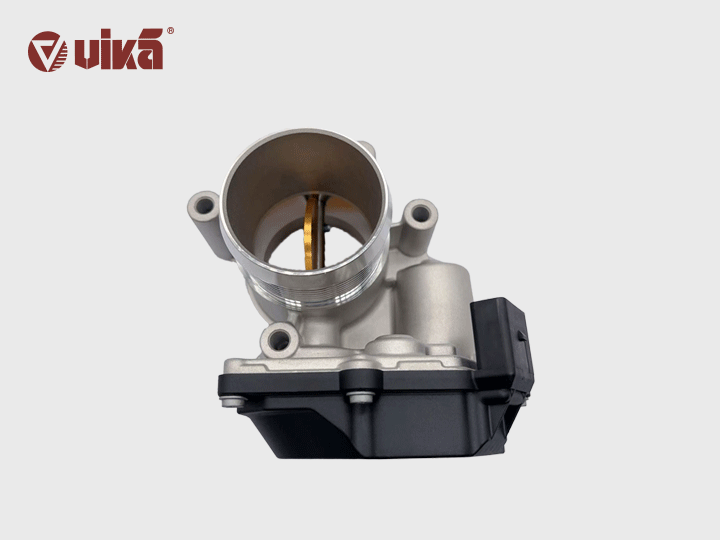
Motor limiting structure comparison
vika: Featuring a metal limiting structure, it resists thermal shrinkage and deformation, effectively eliminating sticking risks. The result is smoother operation and enhanced structural integrity.
OE: Injection-molded plastic limiting parts are used, where uneven shrinkage can create a risk of motor drive sticking.
Technical comparison
vika: Built with European-imported chips, it adapts to complex operating conditions and ensures high product stability.
OE: Basic general-purpose chips are used, which offer limited magnetic circuit fault tolerance and are prone to drift after prolonged use.
Throttle plate process comparison
vika: The aluminum throttle plate undergoes an anodizing treatment to minimize oil adhesion, delivering superior corrosion resistance and enhanced surface durability.
OE: Standard aluminum throttle plate material is used, which is prone to oil adhesion and can easily cause sticking.
Repair and purchase recommendations
Q1: Is it safe to keep driving with a faulty throttle body?
A: If the vehicle is experiencing only idle shuddering, it may be driven at low speed to a repair facility. However, if limp mode has been activated, the vehicle should be stopped immediately and roadside assistance should be summoned to prevent catalytic converter damage.
Q2: If the vehicle enters limp mode, does it necessarily mean the throttle body has failed?
A: Not necessarily. Damaged wiring harnesses, loose connectors, and abnormal power supply can also trigger throttle-related fault codes. The standard diagnostic procedure is to monitor the data stream and verify a persistent deviation between the target and actual throttle angles before concluding that the throttle body itself is faulty.
Q3: What are the advantages of an anodized throttle plate?
A: Anodizing creates a stable oxide film on the aluminum throttle plate, minimizing oil adhesion and resisting carbon buildup. This eliminates throttle plate sticking at the source, significantly extending the throttle body's service life.
Recent News
- -Hydraulic Transmission Mounts: Symptoms, Failure & Buyer Guide
- -Brake Caliper Repair Kit vs. Caliper Assembly: Why Is a Repair Kit the Preferred Choice for Maintenance?
- -Fix Audi Noise & Steering Pull: vika Control Arm Bushing Kit
- -VW 1.6 2.0 TDI Tandem Pump 04L145208D: Failures & vika Fix
- -vika Steering Tie Rod Repair Kit: Fix Chassis Noise & Drift
- -vika Thermostat Assembly: Designed to Solve Coolant Leakage and Check Engine Light Issues


