

Brake Caliper Repair Kit vs. Caliper Assembly: Why Is a Repair Kit the Preferred Choice for Maintenance?
10-28,2026
Brake calipers are core components of driving safety. After prolonged use, they are prone to faults such as piston corrosion, seal aging, and torn dust boots. For auto parts dealers, wholesalers, and repair shop purchasing managers, when the caliper's metal housing is intact, directly replacing the caliper assembly often results in unnecessary cost increases and excess inventory.
A thorough understanding of common brake caliper failure symptoms, their root causes, and the supply chain advantages of repair kits enables you to optimize your inventory structure and deliver cost-effective, highly reliable braking solutions to end customers.
Five caliper failure signals you must watch out for
Caliper failure rarely happens suddenly. It usually develops gradually after the dust boot is damaged. If any of the following symptoms appear, the caliper should be inspected promptly.
1. Brake fluid leakage, with the fluid level in the reservoir continuously dropping
Brake fluid stains and dark, oily sludge appear on the inner side of the wheel hub. In severe cases, brake fluid can be flung onto the brake disc and brake pads, directly reducing braking performance and creating a serious safety hazard.
2. One-sided brake drag and localized abnormal wear on the brake pads
One set of pistons on the same caliper seizes and fails to retract, causing one brake pad to wear abnormally fast. Continuous friction noise is heard while driving, and the vehicle exhibits one-sided brake drag.
3. Soft brake pedal and insufficient braking force
The brake pedal feels soft and spongy, with noticeably longer travel, resulting in a clear lack of overall braking power.
4. Brake pedal vibration and unstable braking force
During hard braking, the steering wheel or brake pedal vibrates noticeably. Multi-piston calipers exhibit uneven, unstable braking force.
5. Abnormal braking noise
A sharp friction noise or continuous disc-rubbing sound is heard while driving or braking.
Causes of brake caliper failures
The vast majority of repairable caliper failures stem from the failure of two core components:
1. Piston surface corrosion / wear and scoring (most common)
When the dust boot is damaged, moisture seeps in and corrodes the piston's chrome plating, causing scratches and pitting on the surface. As a result, the piston fails to retract smoothly and may seize in localized areas.
2. Seal aging, leading to brake fluid leakage from the caliper
High-temperature aging of multi-piston seals causes brake fluid to seep out from the piston dust boot area
Why is a caliper repair kit the preferred choice?
When the caliper housing is undamaged, directly replacing the complete caliper assembly is not the optimal solution. By comparison, purchasing and promoting brake caliper repair kits offers considerable commercial and practical value:
Significantly reduced parts costs and increased profit margins
The purchase price of a repair kit is far lower than that of a new or remanufactured caliper assembly.
In cases involving only non-structural damage such as fluid seepage or rubber aging, the material cost for a single-side repair can be reduced by over 70%, giving end repair solutions a strong competitive edge and considerable profit flexibility.
Maintenance of the vehicle's original braking performance through retention of the original caliper body
As long as the cylinder bore shows no severe pitting or corrosion, the housing is free of cracks, and the threads are intact, there is no need to discard the intact metal body.
Replacing damaged components with a high-quality repair kit fully restores the sealing performance and piston thrust of the original caliper, ensuring that the brake pedal feel after repair matches that of the original vehicle.
Advantages in inventory, warehousing, and logistics
Caliper assemblies are bulky and heavy, which drives up warehousing and cross-border/cross-regional transportation costs and ties up significant capital.
Repair kits are small and lightweight, and take up minimal warehouse space. They not only significantly reduce logistics and stocking costs, but also greatly improve turnover efficiency.
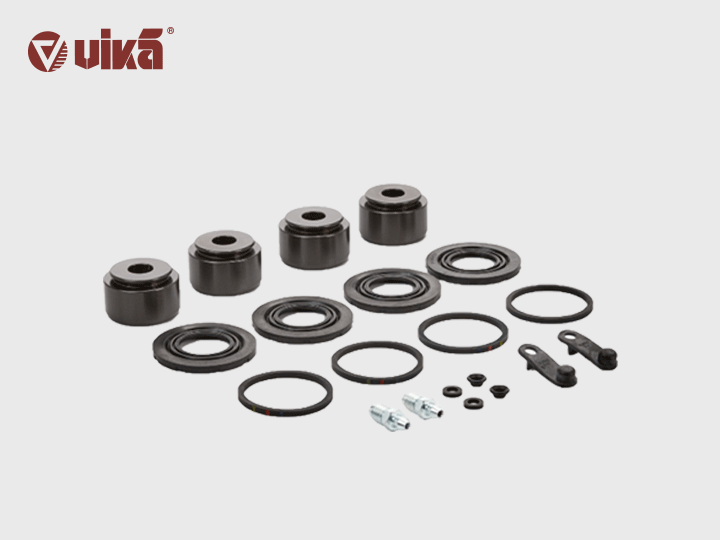
Main components of the vika brake caliper repair kit
Caliper pistons (4 pieces)
Seal rings and dust boots (4 sets)
Bleeder screws with dust caps (2 pieces)
When is it appropriate to use a vika brake caliper repair kit?
The caliper housing, cylinder bore, and mounting threads are intact.
Faults include fluid leakage, piston seizure, brake drag, uneven wear, and a soft pedal.
The vehicle is equipped with original multi-piston calipers, and the goal is to retain the factory braking performance.
Dealers want to lower stocking costs, while repair shops want to boost repair profits.
If the cylinder bore has deep corrosion pits or the housing is cracked, replacing the assembly directly is recommended.
Conclusion
Brake caliper repair kits are not merely a "cost-effective alternative", but precision-engineered components designed to resolve failures while the caliper housing remains intact. For repair shops targeting high bay efficiency and customer satisfaction, and for dealers aiming for high inventory turnover and healthy gross margins, adopting a standard protocol of "assessing the housing first before choosing between a repair kit and an assembly" creates significantly greater long-term value than simply prioritizing high-cost complete assemblies.
Recent News
- -Fix Audi Noise & Steering Pull: vika Control Arm Bushing Kit
- -VW 1.6 2.0 TDI Tandem Pump 04L145208D: Failures & vika Fix
- -vika Steering Tie Rod Repair Kit: Fix Chassis Noise & Drift
- -vika Thermostat Assembly: Designed to Solve Coolant Leakage and Check Engine Light Issues
- -Connecting the World and Empowering the Industry! vika DPA Debuts at Automechanika Frankfurt 2026
- -Why Should the Timing Belt and the Coolant Pump Be Replaced as a Set?


