

vika Steering Tie Rod Repair Kit: Fix Chassis Noise & Drift
09-23,2026
Clunking noises from the chassis, a loose or floating steering feel, and high-speed steering drift are common complaints in auto repair shops. While many technicians initially suspect shock absorbers or control arms, chassis diagnostics frequently reveal worn tie rod ends and rack ends (ball joints) as the root cause.
For repair shops and parts distributors, replacing individual steering components often leads to recurring chassis issues, higher labor costs, and customer comebacks. The vika steering tie rod repair kit offers a complete, all-in-one solution—allowing technicians to restore precise steering responsiveness and eliminate chassis noise in a single service
Common failure symptoms
If the vehicle's steering system exhibits any of the following abnormal conditions, it is recommended to immediately lift the vehicle and inspect the steering mechanism in the chassis:
Abnormal noise on bumpy roads: When the vehicle passes over a speed bump or a pothole, a distinct metallic "clunking" noise is heard from the chassis.
Loose ball joint: When the vehicle is on a lift, rocking the tire will reveal noticeable clearance in the ball joint.
Increased steering free play: The vehicle pulls to one side at highway speeds, with imprecise steering feedback.
Damaged dust boot: Cracks in the steering gear dust boot lead to grease leakage, allowing dirt and water to enter the ball joint.
Failure cause analysis
Damage to the chassis steering system is often not a failure of a single component, but rather a chain reaction:
1. Failure of the steering gear dust boot seal
Rubber aging: Prolonged exposure to high temperatures in the chassis, road salt, and oil contamination causes the rubber to harden and crack.
External damage: Impact from flying stones while driving, chassis scraping against curbs, or incorrect lift pad placement can directly tear the dust boot.
Loose clamp: Metal clamp fatigue causes loosening, allowing the dust boot to shift and exposing the opening directly to dirt and water.
The dust boot serves as the first line of protection for the steering tie rod. Once it fails, mud, water, sand, and gravel can enter the ball joint, rapidly accelerating wear and corrosion.
2. Damaged tie rod / tie rod ball joint
Once the dust boot is damaged and water enters, the tie rod ball joint will develop the following chain of problems:
Worn ball socket bushing: Wear on the plastic bushing creates play; when the tire is rocked, a noticeable impact from the clearance can be felt by hand at the inner ball joint.
Ball joint corrosion and sticking: Steering becomes heavier on one side, steering return is poor, and a "clunking" noise occurs when turning the steering wheel at low speeds.
Inner tie rod thread corrosion: Threads become seized when adjusting the toe, and excessive force during adjustment leads to thread stripping.
Why is a complete set replacement recommended?
In actual repair scenarios, replacing only the dust boot or a single ball joint often leads to a very high risk of rework. Using a repair kit for a complete replacement resolves chain failures, saves labor costs, and ensures driving safety.
1. Chain failure propagation
Dust boot cracking allows dirt and debris to intrude, leading to lubrication failure and directly accelerating ball joint wear and looseness.
2. Hard-to-detect hidden damage
Early-stage ball joint corrosion is often difficult to detect during on-site inspections. Replacing only the dust boot without addressing the underlying corrosion will lead to rapid recurrence and rework.
3. High removal, installation, and alignment costs
Labor costs for chassis component removal and installation are high. Replacing the complete set requires only one removal and installation and one wheel alignment, preventing repeated disassembly that could damage the threads.
4. Complete range of parts in line with OE specifications
Old clamps and nuts are prone to damage or loosening during removal. The repair kit includes all accessories that meet OE specifications, eliminating the need for makeshift solutions and making installation more efficient.
What components are included in the vika Steering Tie Rod Repair Kit?
To enable one-stop, worry-free repair, the vika Steering Tie Rod Repair Kit precisely integrates all core components required for chassis restoration:
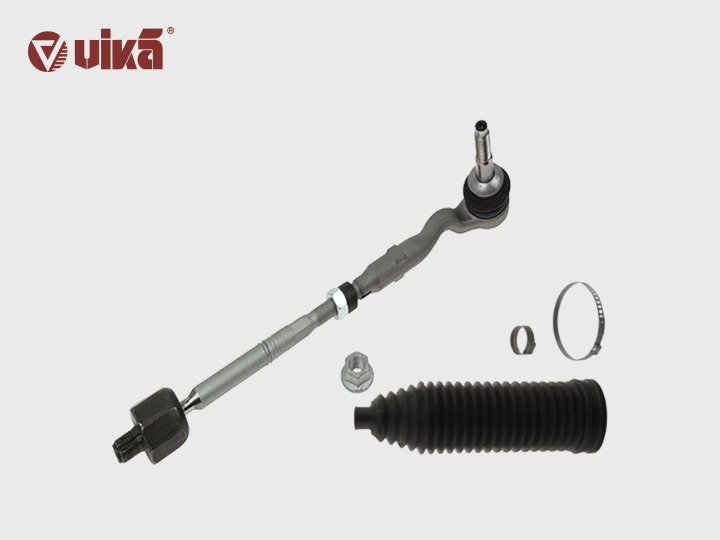
Steering gear dust boot: It restores sealing protection and prevents mud and water intrusion.
Large and small clamps: Brand-new clamps ensure tight locking at both ends, preventing the dust boot from shifting or coming loose.
Steering tie rod assembly: It addresses internal problems such as ball joint wear and excessive play.
FAQs
Q1: How often should a steering tie rod repair kit be replaced?
A: There is no fixed replacement interval. It is recommended to check the dust boot for cracks or grease leakage, and the ball joint for play, during each maintenance service. If the dust boot is damaged or the ball joint is loose, it should be replaced promptly.
Q2: Can the dust boot be replaced separately?
A: If the dust boot has only just been damaged and the ball joint has not been exposed to water or corroded, the dust boot can be replaced separately. However, if play, abnormal noise, or corrosion has already occurred, it is recommended to replace the entire repair kit as a complete set to avoid short-term rework.
Q3: Is it necessary to perform a wheel alignment after replacing the steering tie rod repair kit?
A: Yes. Replacing the tie rod or ball joint will alter the toe setting, so a wheel alignment is required; otherwise, the vehicle may pull to one side and the tires may wear unevenly.
Q4: Why is it necessary to replace the clamps and other accessories in the repair kit together?
A: Old clamps tend to loosen due to metal fatigue after being removed and refitted, and old nuts may strip. Buying parts separately can lead to missing or mismatched components. A complete kit guarantees good matching (in line with OE specifications), supplies everything in one set, and prevents repeated disassembly and rework.
Recent News
- -vika Thermostat Assembly: Designed to Solve Coolant Leakage and Check Engine Light Issues
- -Connecting the World and Empowering the Industry! vika DPA Debuts at Automechanika Frankfurt 2026
- -Why Should the Timing Belt and the Coolant Pump Be Replaced as a Set?
- -BMW 7 Series (E65/E66) Door Lock Assembly Fault Analysis and vika Replacement Solution
- -vika Driveshaft Repair Kit: Eliminate Chassis Noise and Vibration
- -Eliminate Rework! Fault Diagnosis of Front Crossmember Bushings and vika Complete Solution


