

Hydraulic Transmission Mounts: Symptoms, Failure & Buyer Guide
11-11,2026
The transmission mount is a critical vibration-damping component that connects the vehicle body to the powertrain. By combining rubber elasticity with internal hydraulic fluid damping, it effectively absorbs shocks and vibrations generated by the engine and transmission. This article covers replacement intervals, common failure symptoms, root causes of damage, and buying advice for hydraulic transmission mounts.
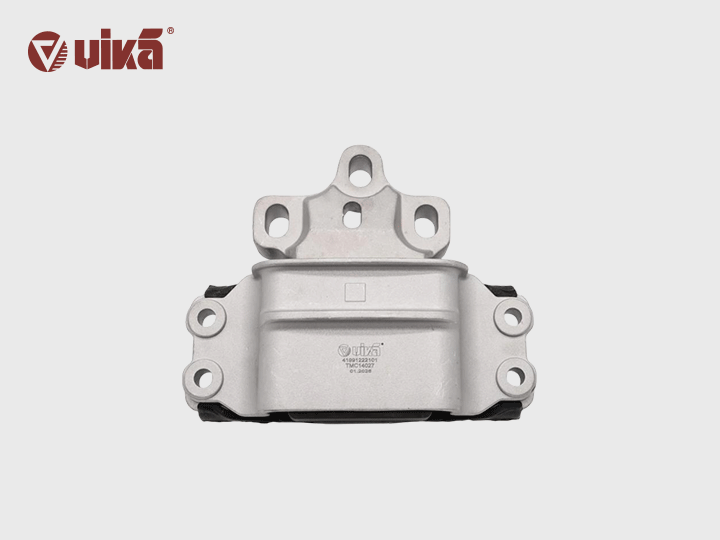
Transmission mount replacement intervals
Recommended replacement interval: 8–10 years or 120,000–150,000 km.
Common failure symptoms and self-inspection methods
When a transmission mount ages or fails, the vehicle typically exhibits the following abnormal noises and vibrations:
Shift shock and clunking noise: A noticeable jolt is felt when engaging a gear, accompanied by a "clunk" sound from the underbody.
Idle vibration: When idling in D or R gear, the vehicle body vibrates abnormally and the steering wheel transmits a noticeable buzzing sensation to the driver's hands.
Low-frequency resonance hum: A low-frequency humming or resonant noise is heard inside the cabin during acceleration or when releasing the accelerator.
Visible damage and excessive play: The rubber shows cracks or sagging, and may even leak hydraulic fluid, resulting in excessive play of the transmission.
Analysis of core failure causes
Transmission mount failure is typically caused by the following factors:
Prolonged vibration and aging: Long-term cyclic flexing causes the rubber matrix to age, harden, and sag permanently.
Thermal cycling degradation: Repeated exposure to extreme high and low temperatures causes the rubber's elasticity to gradually deteriorate.
Inferior rubber materials: Low-end products use a low proportion of virgin rubber, resulting in poor fatigue resistance.
Harsh driving conditions: Aggressive driving, frequent acceleration and braking, or prolonged exposure to congested traffic and poor roads accelerates premature rubber aging.
Hydraulic mounts vs. rubber mounts: comparison
Transmission mounts commonly available on the market today fall mainly into two categories: traditional rubber mounts and hydraulic mounts. Understanding the differences between them can help clarify replacement needs:
Comparison item | Rubber mount | Hydraulic mount |
Structural composition | Metal bracket + rubber block | Metal bracket + main rubber spring + hydraulic damping chamber |
Vibration damping principle | Pure rubber deformation for vibration absorption | Dual vibration absorption through rubber deformation and fluid flow damping |
NVH isolation capability | Adequate high-frequency vibration isolation, but poor low-frequency damping (at idle and under acceleration), making it prone to resonance and shaking. | Full-band vibration isolation: Hydraulic damping absorbs low-frequency vibrations while rubber isolates high-frequency vibrations. |
Dynamic support | Fixed stiffness leads to excessive displacement during hard acceleration and braking, making the body feel loose. | Dynamic variable stiffness: excellent cushioning at small amplitudes and strong support at large amplitudes. |
Impact resistance | Poor cushioning performance, with impacts transmitted directly when driving over potholes or bumps. | Hydraulic damping absorbs impacts instantly, providing smooth cushioning. |
Operating condition adaptability | Suitable only for mild urban driving; performance is limited under aggressive driving or complex road conditions. | Suitable for all operating conditions, with stable performance in aggressive driving, highway cruising, and complex road conditions. |
Core advantages of the vika transmission hydraulic mount
To address the pain points of traditional mounts, such as premature collapse and accelerated degradation, the vika transmission hydraulic mount delivers superior shock resistance, temperature stability, and vibration suppression.
Thailand OEM-grade natural rubber: With a 60% high virgin rubber content, it delivers 30% better durability than ordinary blended rubber and resists hardening and collapse across a wide temperature range.
Ethylene glycol-based damping hydraulic fluid: It maintains stable performance from -40°C to 120°C, with excellent low-temperature flowability, high-temperature vapor lock resistance, and superior dynamic and static stiffness characteristics.
Inertia track plate featuring an OEM-equivalent structural design: It precisely filters high- and low-frequency vibrations in stages for highly effective resonance suppression.
Recent News
- -Brake Caliper Repair Kit vs. Caliper Assembly: Why Is a Repair Kit the Preferred Choice for Maintenance?
- -Fix Audi Noise & Steering Pull: vika Control Arm Bushing Kit
- -VW 1.6 2.0 TDI Tandem Pump 04L145208D: Failures & vika Fix
- -vika Steering Tie Rod Repair Kit: Fix Chassis Noise & Drift
- -vika Thermostat Assembly: Designed to Solve Coolant Leakage and Check Engine Light Issues
- -Connecting the World and Empowering the Industry! vika DPA Debuts at Automechanika Frankfurt 2026


