

vika Thermostat Assembly: Designed to Solve Coolant Leakage and Check Engine Light Issues
09-16,2026
The engine cooling system is critical to ensuring stable powertrain operation. As the core of temperature regulation, a faulty thermostat can directly cause coolant leaks and illuminate the check engine light, potentially leading to severe engine overheating.
Many German-brand vehicles reach a peak failure period for their thermostat and associated coolant hoses after 7-12 years or 100,000-150,000 kilometers.
Common failure symptoms:
Visible coolant leaks in the engine bay and a continuous drop in the expansion tank level.
Illumination of the dashboard check engine light.
Irregular engine warm-up and intermittent cabin heat, with an overheating warning in severe cases.
Failure cause analysis:
Hose and sealing ring failure: Coolant hoses rupture, or sealing rings degrade and crack due to prolonged exposure to high temperatures, leading to seal failure.
Housing leakage: The plastic housing of the original thermostat cracks and leaks coolant due to long-term thermal cycling.
Thermostat core failure: Wax leakage from the core or spring aging causes pushrod failure, preventing the thermostat from opening and closing properly.
How does the vika thermostat assembly solve these problems?
To address the common issue of aging and cracking in OEM plastic parts, vika has launched an upgraded thermostat assembly featuring dual improvements in materials and craftsmanship across all key components:
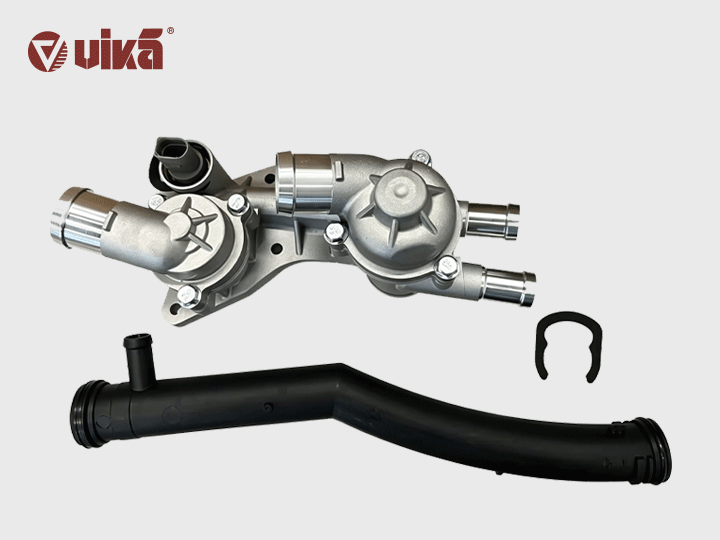
Thermostat: The housing has been upgraded from OEM plastic to ADC12 aluminum alloy, delivering superior high-temperature resistance and anti-aging performance. This eliminates the common issue of OEM plastic housings becoming brittle and cracking under prolonged heat exposure, significantly extending service life. Additionally, the coolant hose port is precision-machined for enhanced roundness and flatness on the mating surface, minimizing potential leakage at the connection point.
Retaining clip: Constructed from PA66-GF30 material, it provides secure axial locking and positioning for the coolant hoses. This prevents hose loosening or displacement, ensuring a more reliable assembly.
Coolant hose: Constructed from PA66-GF30 material, it withstands continuous coolant operating temperatures of up to 130°C under cooling system conditions, offering excellent resistance to high-temperature hydrolysis and maintaining structural stability.
FAQ
Q: How to determine whether a thermostat has failed?
A: Common failure symptoms include a drop in coolant level, visible leaks in the engine bay, illumination of the check engine light, and unstable coolant temperature or intermittent cabin heating.
Q: Is an aluminum alloy housing really better than a plastic one?
A: Yes. Unlike plastic, aluminum alloy resists embrittlement and cracking under high temperatures, delivering superior durability and extended service life.
Q: Why is it recommended to replace the thermostat and coolant hoses simultaneously during repairs?
A: Both components are subjected to the same high-temperature and thermal cycling conditions over extended periods, resulting in similar aging rates. Replacing the thermostat alone while retaining the original aged hoses will likely lead to recurring leaks in the short term, whereas replacing them as a set eliminates the need for a second disassembly.
Recent News
- -Connecting the World and Empowering the Industry! vika DPA Debuts at Automechanika Frankfurt 2026
- -Why Should the Timing Belt and the Coolant Pump Be Replaced as a Set?
- -BMW 7 Series (E65/E66) Door Lock Assembly Fault Analysis and vika Replacement Solution
- -vika Driveshaft Repair Kit: Eliminate Chassis Noise and Vibration
- -Eliminate Rework! Fault Diagnosis of Front Crossmember Bushings and vika Complete Solution
- -Volkswagen Lavida Window Regulator Replacement Guide (2013-17)


