

BMW E65/E66 Door Lock 51217202119: Failure Causes & vika Solution
06-24,2026
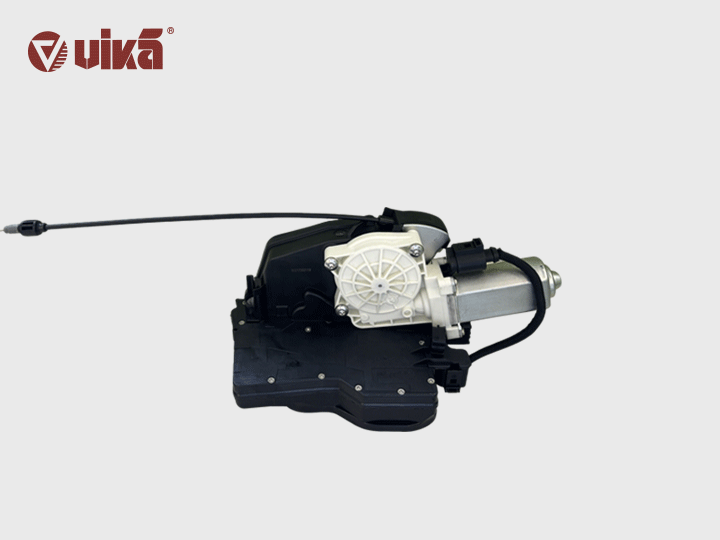
As fourth-generation luxury sedans, the BMW 7 Series models (E65/E66) set a benchmark in the luxury car market. However, as these vehicles age, failure of the soft-close function in the door lock assembly has become one of the most common aging-related issues for the E65/E66 models.
Statistical data indicates that the initial onset of this failure mode typically occurs at 80,000 –120,000 km, with the highest failure rate observed in the 120,000 - 180,000 km range. Severe deterioration generally appears beyond 200,000 km. Chronologically, minor early-stage symptoms emerge at 5–7 years of vehicle age, followed by a widespread peak at 8–10 years, and complete failure after more than 10 years of service.
This article provides an in-depth analysis of the working principle and root causes of failure for the BMW E65/E66 door lock assembly, and offers you a high-quality alternative solution.
Working principle of the BMW E65/E66 door lock assembly
The door lock assembly on the BMW 7 Series (E65/E66) is a sophisticated unit that integrates mechanical and electronic control systems. The soft-close function operates as follows:
1. Half-latch signal activation: When the door is closed to the half-latch position, the microswitch inside the latch mechanism immediately sends a signal to the door control module.
2. Soft-close motor activation: Once the control module receives a signal, it powers the soft-close motor, which uses the pull-arm and fork mechanism to smoothly move the latch bolt from half-latch to full-latch.
3. Real-time status feedback: The Hall sensor integrated within the latch assembly continuously monitors and reports the current lock state (half-latched / fully-latched / unlocked) to the body control module, thereby ensuring synchronization between the door lock status and the vehicle's electronic systems.
This precision electromechanical system provided E65/E66 owners with an exceptionally smooth door-closing experience. However, its intricate design and numerous moving components make it susceptible to various failures with increasing mileage and material aging.
In-depth analysis of four core failures
Based on extensive repair case studies and fault data analysis, failure of the soft-close function in the E65/E66 door lock assembly is attributed primarily to aging and wear in the following four aspects:
Failure 1: Worn Carbon Brushes & Aged Coils — Insufficient Motor Power
The soft-close motor serves as the heart of the latch assembly. After 80,000–120,000 km of operation, the carbon brushes become severely worn and the coil resistance rises, leading to a significant reduction in output torque. Once the motor can no longer generate enough force to move the latch bolt from the half-latch to the full-latch position, the door will fail to close or remain ajar.
Typical symptom: When the door is closed, the motor can be heard running, but the latch bolt fails to engage fully, and the door eventually pops back open.
Failure 2: Worn plastic gear and shift fork — impaired transmission
The plastic gear and fork mechanism inside the lock assembly plays a critical role in converting the motor's rotational motion into the linear motion of the latch. After tens of thousands of opening and closing cycles, the tooth surfaces of these plastic components gradually wear down, gear backlash increases, and power transmission eventually fails.
Typical symptoms: The door's soft-close operation becomes sluggish and intermittent, or it sometimes catches and sometimes doesn't.
Failure 3: Weakening of the Hall-effect sensor magnet — signal confusion
The Hall sensor relies on its internal permanent magnet to detect the position of the latch bolt. Over time, the magnet gradually loses its magnetic strength, causing the Hall sensor to output unstable or incorrect signals. The body control module is thus unable to accurately determine the latch bolt status, and may either refuse to initiate the soft-close procedure or falsely indicate that the latch is fully engaged when it is not.
Typical symptom: The dashboard indicates that the door is ajar even though it has been properly closed, or the soft-close function operates unpredictably without a consistent pattern.
Failure 4: Internal spring fatigue and fracture — mechanical sticking
The return spring and transmission spring inside the latch assembly are under high stress continuously. After repeated compression and release, the springs may suffer fatigue fracture or loss of spring force, causing the latch bolt to either fail to return smoothly or become stuck in a certain position.
Typical symptom: After unlocking, the latch bolt fails to extend, preventing the door from opening; or after closing, it fails to retract, preventing the door from shutting properly.
vika door lock assembly — a durability solution engineered specifically for the E65/E66
Faced with the high replacement cost of original equipment lock assemblies, a growing number of BMW owners are turning to high-quality alternative solutions. The vika door lock assembly is precisely designed to address the core pain points of the E65/E66 lock assembly, with comprehensive optimizations in materials, manufacturing processes, and design.
Enhanced Wear Resistance: Premium OEM-Grade DC Motor
The vika door lock assembly is equipped with an industry-leading miniature DC motor from a joint-venture brand. Significant improvements have been made in brush material, coil winding process, and bearing precision. The result is smoother, more efficient, and more durable operation, fundamentally eliminating the issue of premature motor aging.
Superior Fatigue Resistance: Imported SWP Music Wire Springs
Imported SWP music wire springs are used. This material features high strength and high toughness. Even after hundreds of thousands of compression cycles, it maintains strong elasticity without sagging, completely eliminating the risk of fatigue fracture.
Exceptional Aging Resistance: DuPont & Polyplastics Raw Materials
The gear and fork mechanism inside the lock assembly is molded from high-performance raw materials supplied by globally renowned brands such as DuPont and Polyplastics. These materials offer excellent resistance to heat, wear, and aging, ensuring long-term dimensional stability and resistance to deformation. This effectively prevents premature wear in plastic gears.
Maximum Longevity: High-Performance NdFeB Magnets (N35/N52)
The vika door lock assembly uses high-performance NdFeB magnets (N35/N52) characterized by stronger magnetic force, slower demagnetization, and excellent aging resistance. This ensures long-term stability and reliability of the Hall sensor signal, significantly extending the overall service life of the lock assembly.
List of vehicle models compatible with vika 51217202119 door lock assembly
The vika door lock assembly is perfectly compatible with the following BMW 7 Series (E65/E66) models:
BMW 7 Series Short-Wheelbase (E65), 2001–2008
730i, 740i, 745i, 750i, 760i
BMW 7 Series Long-Wheelbase (E66), 2001–2008
730Li, 745Li, 750Li, 760Li
The self-close system of the BMW 51217202119 door lock assembly is a prime example of high-precision mechatronic engineering. With approximately 1 million vehicles worldwide now entering the high-failure period at 120,000 – 180,000 kilometers, choosing a reputable aftermarket brand that provides long-lasting technical reliability is essential.
With four core upgrades – a reinforced motor, optimized spring, advanced materials, and a stronger magnet – the vika door lock assembly delivers a more durable, reliable, and cost-effective solution for BMW owners. If you're experiencing issues with a faulty E65/E66 lock assembly, vika is the reliable choice you can trust.
Recent News
- -Fix Audi Noise & Steering Pull: vika Control Arm Bushing Kit
- -VW 1.6 2.0 TDI Tandem Pump 04L145208D: Failures & vika Fix
- -vika Steering Tie Rod Repair Kit: Fix Chassis Noise & Drift
- -vika Thermostat Assembly: Designed to Solve Coolant Leakage and Check Engine Light Issues
- -Connecting the World and Empowering the Industry! vika DPA Debuts at Automechanika Frankfurt 2026
- -Why Should the Timing Belt and the Coolant Pump Be Replaced as a Set?


