

Eliminate Rework! Fault Diagnosis of Front Crossmember Bushings and vika Complete Solution
08-19,2026
After years of use, many vehicles develop abnormal engine and chassis vibrations. Common symptoms include idle shudder of Drive gear, seat vibration, knocking from the chassis under hard acceleration or throttle release, low-speed shift shock, and forward/backward jerking when engaging Drive or Reverse gear. These symptoms can in most cases be traced back to aged and cracked front crossmember bushings.
As a professional supplier deeply rooted in the automotive aftermarket, vika draws on extensive repair cases and OEM structural principles to pinpoint the root causes of front crossmember bushing failures. It also explains why the upper and lower bushings must be replaced as a complete set for delivering a one‑time fix and eliminating the need for repeat repairs.
Typical failure symptoms of damaged front crossmember bushings
The front crossmember bushings are critical cushioning components in the chassis and powertrain system. When they age and fail, the vehicle exhibits very typical and easily self-diagnosable symptoms:
Idle shudder during gear shifting: When shifting into Drive gear with the brake pedal depressed, the vehicle body and seats vibrate noticeably. The vibration subsides to some extent after switching to Neutral gear.
Impact noise during acceleration and deceleration: A knocking noise from the chassis or engine compartment is heard during hard acceleration or throttle release.
Pronounced jerk during low‑speed gear shifting: The vehicle exhibits noticeable shift hesitation and jerking during low‑speed upshifts and downshifts.
Stationary gear shifting jerk: When shifting into Drive or Reverse gear while stationary, the vehicle exhibits a pronounced forward‑and‑backward jerking motion.
Root causes of front crossmember bushing aging and failure
The front crossmember bushings are rubber consumables mounted beneath the engine and transmission. Though they may seem unremarkable, they operate in an extremely harsh environment:
Intense heat generated by the engine: The engine generates significant heat during operation. With the bushings constantly exposed to high temperatures over time, the rubber undergoes accelerated aging, becoming hard, brittle, or tacky.
Corrosion from engine oil and oil vapor: The underside of the engine and transmission is often exposed to engine oil, transmission fluid, and oil vapor. When these contaminants permeate the rubber, they can cause swelling, solvation, and cracking.
Fatigue from sustained vibration: The continuous vibration, impact shocks, and thermal cycling during driving constantly degrade the rubber's elastic structure.
Under this triple onslaught, it is only a matter of time before the rubber ages, cracks, and loses its elasticity. For most vehicles, noticeable performance degradation occurs between 50,000 and 80,000 kilometers or 4 to 6 years of service, with failures peaking around 70,000 kilometers.
Why must the front crossmember bushings be replaced as a complete set (upper and lower)?
Many vehicle owners or inexperienced mechanics tend to replace only failed components during maintenance. However, when it comes to front crossmember bushings, replacing just one side is a common mistake.
1. The bushings feature an integral load-carrying design and are not standalone parts
The front crossmember bushings consist of an upper bushing and a lower bushing, with the transmission lower support arm located between them. The impact forces generated during forward/backward drivetrain movement, hard acceleration, and braking are shared simultaneously by both bushings. They function as a coordinated elastic unit rather than independent components.
2 Both bushings age at the same rate and share the same lifespan
The upper and lower bushings are subjected to virtually identical environmental conditions, including the same heat exposure, oil contamination, and fatigue loading. By the time one bushing shows cracking or sagging, the other has already experienced significant loss of elastic properties.
3. Replacing only one bushing can trigger a cascade of problems
If only one of the bushings is replaced, e.g., the upper one, the following consequences may arise:
Force imbalance: The new bushing remains firm with minimal deflection, while the old one has softened and sagged. This creates a severe load imbalance in the support structure.
Repeated failure: Shortly after the replacement, the idle vibration, shift jerking, and knocking noise will return.
Secondary damage: As the softened old bushing can no longer absorb any impact, all engine torque and dynamic loads are transferred entirely to the new bushing. As a result, the new bushing may become overstressed and crack again within just a few months.
4. Replacing as a set reduces overall repair costs
Replacing the front crossmember bushings requires removing the front crossmember, which is a time‑consuming job. The labor cost for removing and reinstalling the crossmember alone often far exceeds the cost of the bushings themselves. If you replace only one bushing to save a few bucks, you will likely have to pull the crossmember apart again months later for the other one, doubling the labor cost in a classic false economy.
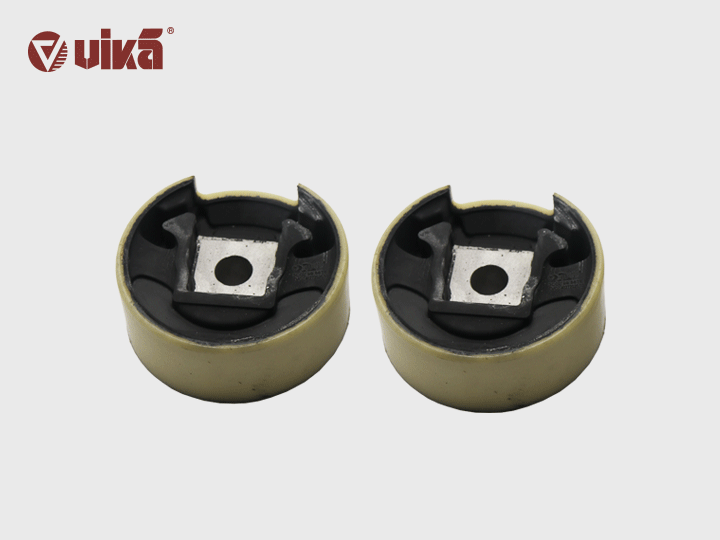
vika front crossmember bushing repair kit solution
To address chassis vibration and abnormal noise in Volkswagen models, vika introduces the "Easily vika" series. It is an innovative front crossmember bushing repair kit solution that delivers a more convenient and professional repair experience for workshops and vehicle owners alike.
The kit includes both the upper and lower front crossmember bushings, precisely matched to the original assembly structure and fully compliant with the complete‑set replacement standard.
vika DPA Joy Carnival Season VII is in full swing, with limited-time discounts on many products. Welcome to inquire and purchase.
Recent News
- -Fix Audi Noise & Steering Pull: vika Control Arm Bushing Kit
- -VW 1.6 2.0 TDI Tandem Pump 04L145208D: Failures & vika Fix
- -vika Steering Tie Rod Repair Kit: Fix Chassis Noise & Drift
- -vika Thermostat Assembly: Designed to Solve Coolant Leakage and Check Engine Light Issues
- -Connecting the World and Empowering the Industry! vika DPA Debuts at Automechanika Frankfurt 2026
- -Why Should the Timing Belt and the Coolant Pump Be Replaced as a Set?


