

End DQ200 0AM Accumulator Cracking with vika Steel Base
07-22,2026
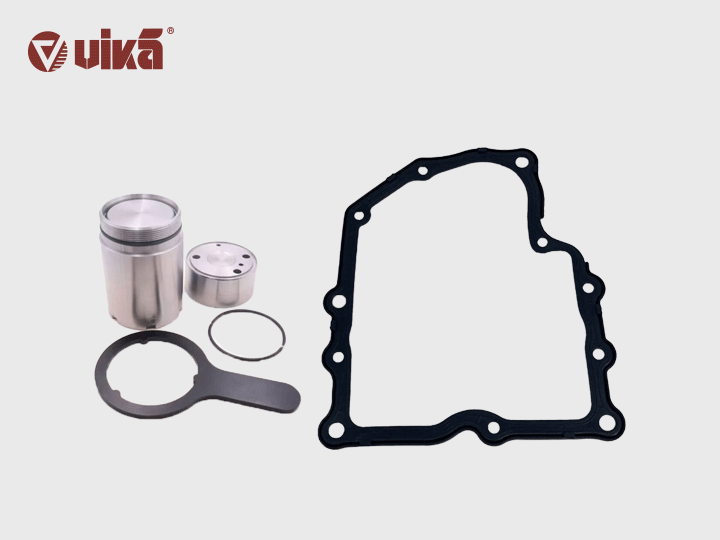
Accumulator base cracking has long been the most prevalent and critical pain-point failure in the Volkswagen DQ200 (0AM) 7-speed dry dual-clutch transmission.
Why does the original aluminum valve seat fail frequently at 60,000–80,000 kilometers? How to completely eliminate cracking risk? This article provides an in-depth analysis of the DQ200 accumulator's operating principle, the root causes of cracking, and the technical breakthrough of the upgraded steel base solution of vika.
Working principle of accumulator
In the DQ200 transmission, hydraulic pressure is generated by a motor-driven oil pump, while the accumulator acts as the system's central energy reservoir. The system operates as follows:
Energy storage process: The electric motor drives the oil pump to generate pressure. The high-pressure oil is directed into the accumulator, compressing the pre-charged nitrogen gas to store energy.
Pressure replenishment and buffering: When hydraulic pressure is required for system gear shifts or clutch actuation, the compressed nitrogen rapidly expands to force the hydraulic fluid out. This process stabilizes system pressure, maintains holding pressure, dampens shocks, and provides an emergency oil supply.
Functions of the accumulator
Pressure stabilization and maintenance: It maintains constant hydraulic system pressure, enabling the oil pump to operate intermittently rather than continuously. This significantly improves system efficiency and extends motor lifespan.
Shock Absorption: By absorbing pressure fluctuations during clutch actuation and shifting, it prevents driveline jerks and safeguards the valve body and pistons against abnormal mechanical wear.
Rapid Response: It provides millisecond-level pressure replenishment during gear shifts, reducing transmission response time and enhancing shift smoothness.
Emergency function: In the event of sudden oil pump failure or engine stall, it provides short-term hydraulic pressure to maintain basic gear shifting capability.
Why does the DQ200 accumulator develop cracks at 60,000–80,000 kilometers?
According to aftermarket data from over 10 million vehicles with DQ200 transmission, the original parts enter a high-failure period when the vehicle reaches 5–6 years of age or 80,000–100,000 kilometers of mileage.
Original flaw: The original mechatronics unit base is constructed from cast aluminum alloy with an inadequate safety margin. This makes it highly susceptible to fatigue failure under long-term, high-frequency cyclic loading.
Bidirectional tensile pull: The original accumulator's tightening torque is 200 N·m, generating a preload tensile force of over a thousand newtons. The downward force from oil pressure, combined with the thread-induced preload stress, creates a bidirectional pull that further accelerates crack propagation.
Cascading failure: Following the failure of the accumulator, hydraulic pressure fluctuations exacerbate and the impact frequency increases significantly. This causes rapid crack propagation in the base, which can ultimately lead to a catastrophic
base rupture, high-pressure hydraulic fluid ejection, and a complete loss of vehicle power.
vika's innovative split-type solution
To address the inherent structural weakness of the original die-cast aluminum base, which was susceptible to fatigue cracking, vika has abandoned the one-piece design and innovatively adopted a "split-type steel base" structure, completely eliminating the cracking issue at its core.
| Comparison | vika | OE |
| Bas material | Upgraded steel base | Die-cast aluminum base |
| Fatigue strength | ≈280MPa | ≈75MPa |
| Structural design | Split type without stress concentration | One-piece casting, with a thin root section and no reinforcing ribs |
| Impact resistance | No cracks under cyclic loading | Prone to cracking at 60,000–80,000 km |
| Service life | Over 150,000 km | 60,000–80,000 km |
Compatible vehicle models
VAG: GOLF 07-14/JE 06-14/PA 09-15/PO 10-12/SCI 09-14/TOU 09-15/ BE 12-16/ CA 11-15
AUDI: A1 11-14/A3 08-13
SKODA: FAB 11-15/OCT 09-13/SUP 08-13/YET 10-13
Recent News
- -vika Thermostat Assembly: Designed to Solve Coolant Leakage and Check Engine Light Issues
- -Connecting the World and Empowering the Industry! vika DPA Debuts at Automechanika Frankfurt 2026
- -Why Should the Timing Belt and the Coolant Pump Be Replaced as a Set?
- -BMW 7 Series (E65/E66) Door Lock Assembly Fault Analysis and vika Replacement Solution
- -vika Driveshaft Repair Kit: Eliminate Chassis Noise and Vibration
- -Eliminate Rework! Fault Diagnosis of Front Crossmember Bushings and vika Complete Solution


