

Why Must the Shock Absorber Attachments Be Replaced as a Complete Set?
07-29,2026
Many vehicle owners encounter a distinct "clunking" noise when traversing speed bumps, often accompanied by a loose chassis and excessive vibration. While these symptoms are frequently misdiagnosed as shock absorber failure, the root cause is frequently the deterioration and failure of the shock absorber attachment repair kit.
This article provides an in-depth analysis of the shock absorber attachment repair kit, covering its composition, common failure symptoms, and root causes of damage. It also explains why the kit must be replaced as a complete set, and how choosing the vika shock absorber attachment repair kit can greatly reduce maintenance costs
What components are included in the shock absorber attachment repair kit?
The shock absorber attachment repair kit typically includes the core cushioning and protective components that surround the shock absorber.
A standard repair kit typically consists of the following components:
Shock absorber top mount: Functioning as a critical interface between the shock absorber and the vehicle chassis, this component is engineered to absorb road shocks and attenuate vibrations.
Dust boot / Dust cover: It is a protective component that shields the shock absorber piston rod from sand, water, and foreign matter.
Thrust bearing: This component ensures smooth and unhindered steering while the suspension is under load.
Buffer block / Bump stop: This component supports the shock absorber in mitigating road shocks and vibrations, thereby improving the driving stability of the vehicle.
Support plate and fasteners: They provide a stable mounting foundation for the shock absorber assembly.
Typical symptoms of shock absorber attachment failure
When shock absorber attachments become worn or damaged, the vehicle sends clear warning signs. Ignoring these symptoms not only compromises driving comfort, but can also result in costly secondary damage.
Abnormal noise: A dull thumping, clunking, or creaking sound emanating from the rear wheels when traversing speed bumps, uneven roads, or applying the brakes. The noise intensifies during low-speed steering or reversing maneuvers.
Loose chassis and excessive vibration: The vehicle shakes noticeably over uneven roads, with rear-seat passengers feeling strong jolts. The suspension rebounds sluggishly and lacks the crispness associated with a healthy suspension.
Premature shock absorber failure: The shock absorber oil seals leak frequently, and the piston rod shows unusual wear or scratches.
Why do shock absorber attachments become damaged?
Chassis rubber components are constantly subjected to high loads, extreme temperature swings, and road grime. Over time, these materials inevitably exhibit the following symptoms:
Aging of the buffer block material, resulting in loss of elasticity and flexibility;
Dust cover material aging and cracking;
The top mount rubber cracks, compresses, and collapses, eventually separating from the metal core.
Why must the kit be replaced as a complete set?
Many car owners make the mistake of replacing only the visibly damaged part during repairs. This is a common misconception in shock absorber maintenance. In reality, the shock absorber attachments form an interconnected wear system, with each component working in sync with the others. That's why professional practice recommends replacing the entire kit on both sides at the same time. Here are the key reasons:
All components age at a similar rate: When a single component exhibits clear signs of failure, the remaining attachments have already approached the end of their effective service life. Replacing only the defective part will ultimately result in successive failures of the other components in the near term.
The components are mutually dependent: The top mount, buffer block, and related parts are designed to operate as an integrated assembly. Failure of any single component will accelerate deterioration of the remaining parts. Replacing just a single part cannot resolve the underlying systemic issue.
Avoid secondary repairs: It is recommended to replace both sides at the same time to ensure balanced cushioning performance. Replacing the complete set helps prevent a return visit to the repair workshop in the near future, ultimately saving maintenance costs.
Why choose the vika shock absorber attachment repair kit?
Designed to thoroughly resolve chassis noise and prevent premature shock absorber deterioration, the vika attachment repair kit is produced in full compliance with OEM standards. Offered as a comprehensive, single-source replacement for aging attachments, it is a recommended solution for repair workshops and vehicle owners alike.
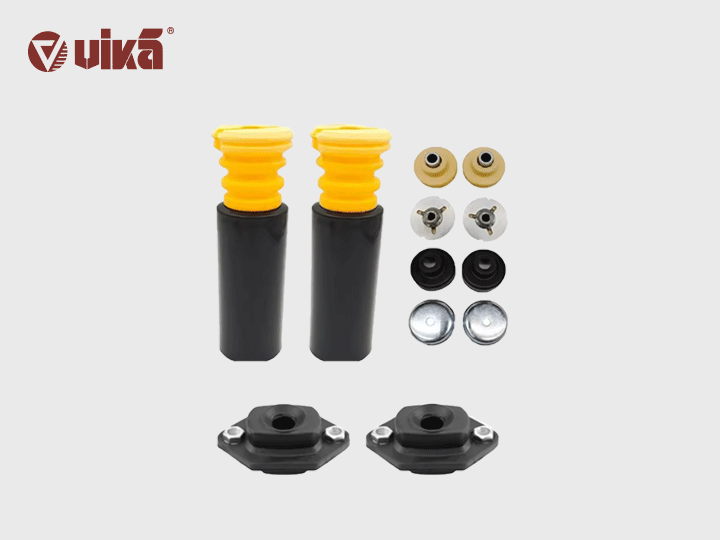
Core advantages of the vika shock absorber attachment repair kit:
Complete components: The kit includes top mount, auxiliary spring, dust cover, thrust bearing, support plate, and other components, eliminating the risk of missing parts and covering all repair needs in one package.
Complete components: The kit includes the top mount, buffer block, dust cover, thrust bearing, support plate, and other components, eliminating the risk of missing parts and covering all repair needs in one package.
Precise compatibility: The kit is engineered to full OEM-grade specifications for a 100% direct replacement. The components can be installed seamlessly with perfect alignment.
FAQ
Q1: Can I replace only the top mount instead of the whole repair kit?
A1: Not recommended. All shock absorber attachments age at the same rate. Even parts that look intact, such as the dust cover, bearing, and buffer block, have already degraded beneath the surface. Replacing just the top mount will unbalance the suspension and lead to problems again, such as noises or looseness, before long.
Q2: Do both sides need to be replaced at the same time when changing shock absorber attachments?
A2: Yes. Both sides of the suspension are exposed to equivalent operating conditions and therefore exhibit comparable aging characteristics. Replacement on one side alone will induce an imbalance in damping force between the two sides, which may result in chassis instability, irregular tire wear, and recurrent abnormal noise. Simultaneous replacement on both sides is recognized as the standard procedure across the industry.
Q3: How often should the shock absorber attachment repair kit be replaced?
A3: Original rubber components typically show significant wear after 5 to 8 years, or around 80,000 to 100,000 kilometers. A thorough inspection and replacement is recommended within this mileage range, or whenever the shock absorbers are replaced.
Recent News
- -vika Thermostat Assembly: Designed to Solve Coolant Leakage and Check Engine Light Issues
- -Connecting the World and Empowering the Industry! vika DPA Debuts at Automechanika Frankfurt 2026
- -Why Should the Timing Belt and the Coolant Pump Be Replaced as a Set?
- -BMW 7 Series (E65/E66) Door Lock Assembly Fault Analysis and vika Replacement Solution
- -vika Driveshaft Repair Kit: Eliminate Chassis Noise and Vibration
- -Eliminate Rework! Fault Diagnosis of Front Crossmember Bushings and vika Complete Solution


