

Half Shaft Assembly Failure? 5 Signs You Can't Ignore
05-27,2026
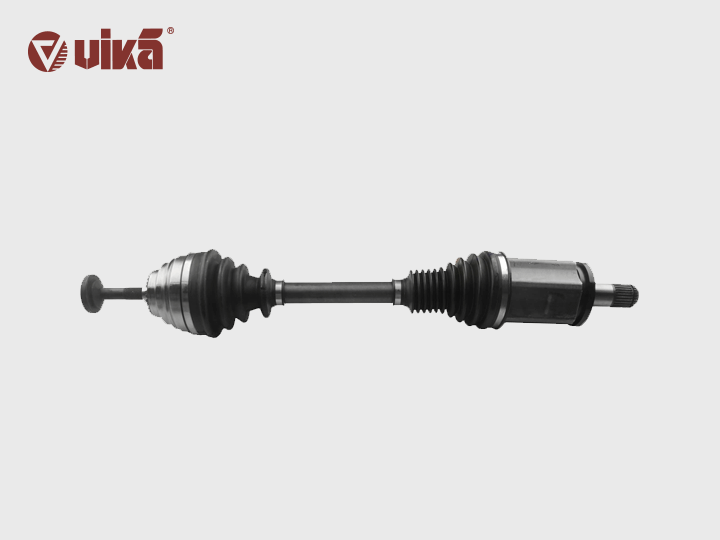
In the drivetrain of a vehicle, the half shaft assembly plays an indispensable role. Many car owners only become aware of its existence when the vehicle experiences vibration during startup or unusual noises when turning. This article will take an in-depth look at the core function of the half shaft assembly, common causes of its failure, and how to choose a high-quality replacement half shaft.
Core functions of the half shaft assembly
As a key part in the drivetrain of a vehicle, the half shaft assembly provides the following main functions:
Power transmission: It smoothly transmits the torque output by the transmission to the driving wheels, propelling the vehicle forward.
Steering adaptation: It works with the outer CV joint to ensure uninterrupted power delivery when the wheels turn left or right.
Bump absorption: Through the free extension and compression of the inner CV joint, it adapts to the vertical movement of the suspension, thereby ensuring a smooth ride.
Constant speed transmission: It maintains a constant speed during power transmission at various output angles, effectively preventing vehicle body vibration and abnormal noise.
Installation position of the half shaft assembly
The half shaft assembly is installed between the transmission/differential and the wheel hub. One half shaft assembly is provided on each side (left and right) of the vehicle's inner chassis suspension, serving as the critical link between the powertrain and the running gear.
Structure of the half shaft assembly
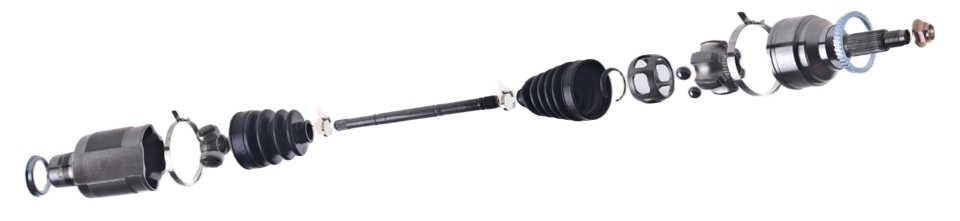
A half shaft assembly consists of the following components: inner CV joint, TJ joint, dust cover, axle shaft, cage, steel balls, dust cover clamp, outer CV joint, and spline. All components work in precise coordination to jointly deliver full functions including power transmission, steering, and protection.
Replacement cycle of the half shaft assembly
The automotive half shaft assembly is a wear part. Under normal circumstances, it should be replaced at around 100,000 to 150,000 kilometers.
If the vehicle frequently travels on rough roads or under heavy load, the half shaft assembly should be inspected and replaced at 100,000 kilometers to prevent aging-related failures that may affect driving safety.
Common failures and reasons of the half shaft assembly
1. Vibration during startup or acceleration
Failure symptom: When the vehicle starts or accelerates sharply, the body and steering wheel vibrate noticeably.
Main cause: The typical causes of this failure include poor dynamic balance of the half shaft, low coaxiality of the shaft body, spline eccentricity or wear-induced looseness, and low machining precision of the CV joint.
2. A continuous "clicking" noise during turning of the vehicle
Failure symptom: When turning the steering wheel or making a turn, a continuous and crisp "clicking" sound can be heard near the front wheels.
Main cause: The outer CV joint is severely worn, with damage to the steel balls or raceways. This is often caused by sand entering through a ruptured dust cover, leading to dry wear due to grease loss and resulting in deformation of the cage.
3. Spline stripping and loose transmission
Failure symptom: When pressing the accelerator, the engine revs without delivering power smoothly, the power transmission feels inconsistent, and the chassis is obviously loose.
Main cause: The spline material is of poor quality, with insufficient hardness and a lack of deep hardening. Poor machining accuracy results in excessive fit clearance, leading to spline stripping under long-term high torque.
4. Steering wheel vibration at high speeds
Failure symptom: When the vehicle speed exceeds 80 km/h, the steering wheel experiences high-frequency and noticeable vibration.
Main cause: The half shaft's dynamic balancing is inadequate, the shaft body deforms under force, or the machining error between the spline and the CV joint is excessive.
5. Dust cover oil leakage or dust ingress
Failure symptom: Chassis inspection shows the dust cover is cracked and the clamp is loose, with oil and grease splattered all around the CV joint.
Main cause: Possible causes include poor weather resistance resulting from inferior material of the dust cover, insufficient clamping force of the clamp, long-term rusting and loosening, unreasonable bellows structure design, and substandard sealing during assembly.
Why choose vika half shaft assembly?
There is a great variety of parts in the automotive aftermarket, and choosing a high-quality half shaft from among them is crucial for vehicle performance. The half shaft assembly manufacturing base of vika holds the national CNAS laboratory accreditation and has achieved 100% in-house control over key manufacturing processes – from forging to finished product.
1. Precision machining process
In a specialized hard turning and milling process, the inner and outer raceways are polished to a mirror-like finish, fully meeting the OEM production standards. This leads to smoother and jam-free transmission.
2. High-strength alloy material for mandrel (connecting rod)
The main structure is made of 20CrMnTi, a high-end carburizing alloy steel, and undergoes a fully automatic precision quenching and tempering process using German EFD equipment. This greatly enhances the material's toughness, hardness, and torsional performance, enabling it to adapt easily to various rugged road conditions such as mountain trails and rough terrains.
3. High-precision spline and thread
World-class equipment, including an American MAG spline rolling machine and a German EFD induction hardening machine, is used to realize one-time synchronous forming of splines and threads to avoid positioning deviations caused by staged processing. The spline accuracy is controlled within a deviation of no more than 0.01 mm. Once installed on the vehicle, it ensures zero vibration, zero resonance, and zero abnormal noise even at high speeds.
High-quality core components
Outer CV Joint: Made of 55# high-strength carbon steel and processed using hard turning and milling, it achieves mirror-like steering precision. It leads to smooth and jam-free steering and provides excellent fatigue resistance, making it suitable for high-torque, high-load vehicles.
Steel ball: It is made of GCr15 high-carbon chromium steel, provides G5 or higher precision, and has a roundness not exceeding 0.5 μm. It operates without dead zones or mechanical impact, completely eliminating the risk of later-stage abnormal noise and vibration.
Dust cover: It is integrally molded from imported CR material and features a multi-layer corrugated structure. It operates within a temperature range of -40°C to 120°C, offering excellent resistance to low temperatures, ozone, acids, alkalis, and oils. Fully compatible with specialized greases, it also exhibits outstanding resistance to flexural fatigue and superior air tightness.
Grease: Sinopec TBF-A extreme pressure lithium-based grease is used. It offers outstanding extreme pressure resistance, anti-wear performance, impact resistance, and water spray resistance, and operates in the temperature range of -40°C to 170°C. It eliminates abnormal noise during cold starts and high-temperature oil slinging.
Dust cover clamp: It is made of high-quality 1Cr13Ni9 material and features a retractable, round-closing structure that provides uniform 360° force distribution without damaging the rubber sleeve. It offers high strength and good toughness, with consistently stable locking force. Resistant to corrosion and salt spray, it does not rust and maintains its shape without loosening even after long-term use, making it suitable for various harsh road conditions.
Although the automotive half shaft assembly is small in size, it directly affects driving safety and ride quality. If your vehicle experiences vibration during startup or at high speeds, or abnormal noises when turning, you should promptly take it to a repair shop to have the half shafts inspected. When replacement is necessary, choose a product like the vika half shaft assembly. It is certified by a national-level laboratory and manufactured using high-strength alloy steel through an OE-grade hard turning and milling process. It guarantees long-lasting high performance.
Recent News
- -Connecting the World and Empowering the Industry! vika DPA Debuts at Automechanika Frankfurt 2026
- -Why Should the Timing Belt and the Coolant Pump Be Replaced as a Set?
- -BMW 7 Series (E65/E66) Door Lock Assembly Fault Analysis and vika Replacement Solution
- -vika Driveshaft Repair Kit: Eliminate Chassis Noise and Vibration
- -Eliminate Rework! Fault Diagnosis of Front Crossmember Bushings and vika Complete Solution
- -Volkswagen Lavida Window Regulator Replacement Guide (2013-17)


