

What are the symptoms of a failed front pressure-reducing bearing?
08-06,2025
A failure of a front pressure-reducing bearing on a vehicle may have direct implications for maneuverability and safety of the vehicle.
Symptoms of a failed front pressure-reducing bearing:
Abnormal sound: A broken ball causes clattering sounds during turning.
Jamming: Track rusting makes the steering wheel more difficult to be straightened.
Grease leakage: There is lubricating grease thrown out of the bearing due to sealing failure.
Possible reasons for failures of a front pressure-reducing bearing:
Sealing failure: The dust cover is damaged, and consequently silt and water enter the bearing, contaminating the grease and accelerating wear.
Insufficient lubrication: The original lubricating grease has dried up, causing dry friction of metal and damage to the ball or track.
Material issues: Ordinary steel bearings used on low-end models may easily experience rust and fatigue-induced cracking.
Driving habits: Passing over speed bumps rapidly and frequently or fully locking the steering wheel can result in excessive impact loads.
Impact of related components: The additional pressure generated due to oil leakage of a shock absorbers or a weak spring can be transmitted to the bearing.
Service life of a front pressure-reducing bearing:
Ordinary family cars: 60,000~100,000 kilometers of mileage.
SUVs/off-road vehicles: 40,000~80,000 kilometers of mileage. The service life of front pressure-reducing bearings used on these vehicles are 30% shorter than those on ordinary cars due to heavier loads and rougher road conditions.
Performance cars/aggressive driving: 30,000~50,000 kilometers of mileage. High-frequency steering and impact can accelerate wear.
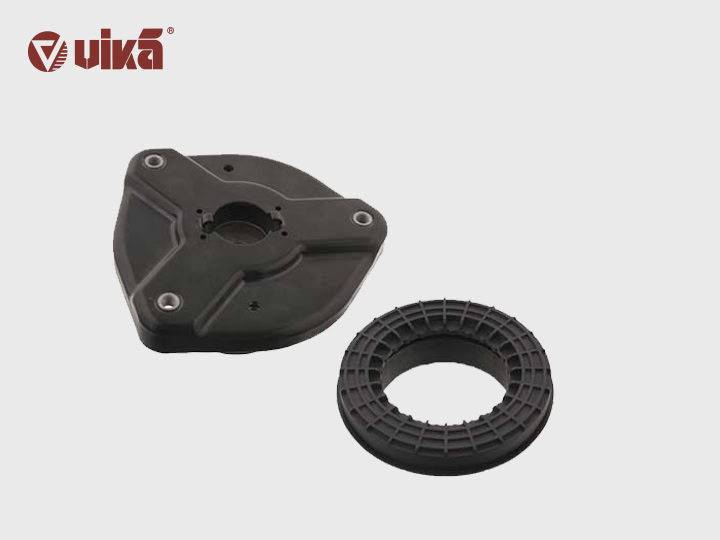
Advantages of vika front pressure-reducing bearing kit:
Steel ball: The steel ball of vika front pressure-reducing bearing kit is made of Gcr15 high-carbon chromium bearing steel, featuring high hardness, excellent wear resistance, and good dimensional stability.
Upper enclosure: It is made of PA66 and GF35 materials, featuring high rigidity, low warpage, excellent creep resistance, and good dimensional stability.
Retainer frame: Made of PA66 and GF25 materials, it is characterized by high tensile strength, large load-bearing capacity, good chemical corrosion resistance, and the ability to operate stably in various chemical media.
Lower enclosure: It is made of PA66 and GF50 materials, featuring ultra-high rigidity, extremely low shrinkage rate, and excellent resistance to high temperatures.
Recent News
- -Throttle Body Failure: Symptoms, Causes and vika STO Upgrade
- -Hydraulic Transmission Mounts: Symptoms, Failure & Buyer Guide
- -Brake Caliper Repair Kit vs. Caliper Assembly: Why Is a Repair Kit the Preferred Choice for Maintenance?
- -Fix Audi Noise & Steering Pull: vika Control Arm Bushing Kit
- -VW 1.6 2.0 TDI Tandem Pump 04L145208D: Failures & vika Fix
- -vika Steering Tie Rod Repair Kit: Fix Chassis Noise & Drift


