

When should be an automotive air conditioning filter element be replaced?
07-19,2023
An automotive air conditioning filter element should be replaced in the following circumstances:
Replacement interval: Depending on vehicle usage and air quality, an automotive air conditioning filter element should be preferably replaced at intervals of 6 months to 1 year.
Odor: When the air conditioner in the car produces an odor, it may be caused by excessive dust, bacteria, or harmful substances in the air conditioning filter element. If this is true, the filter element should be replaced.
Degraded air conditioning performance: If the volume of air coming out of the air conditioner becomes smaller than usual, or if the temperature in the car is no longer as cool as expected, the filter element may have been blocked and resulted in poor air circulation. In this case, the filter element should be replaced.
Higher wind noise: If the wind noise generated by the air conditioner becomes higher, it may be caused by blocking of the filter element. Replacing the filter element will solve this problem.
Visible dirt on the filter element: If dirt or dust is visible during inspection of the filter element, it is necessary to replace it.
Regular replacement of air conditioning filter element helps maintain clean and comfortable air in the car, extend the service life of the air conditioning system, and reduce potential health risks to drivers and passengers.
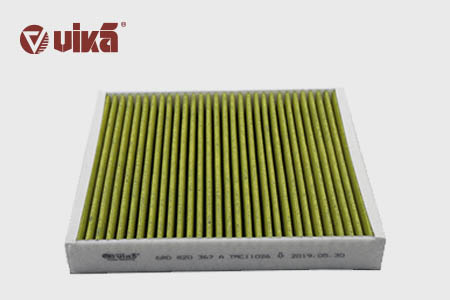
Advantages of vika air conditioning filter elements:
Protection layer of vika air conditioning filter element: The layer is made of PET saturated polyester, which is a high-strength material with strong resistance to shock and corrosion and provides permanent protection for aluminum;
Highly efficient filtering layer of vika air conditioning filter element: A 3M static electret HEPA is adopted to screen out ultra-fine particulates with very high efficiency, with a removal rate exceeding 95%;
Moderately efficient filtering layer of vika air conditioning filter element: A static electret cotton layer is used, which is capable of filtering out 90% PM2.5 particulates while providing a higher dust-holding capacity;
Deodorizing layer: Made of high-quality imported coconut shell activated carbon, it boasts a 300% increase in physical absorption capacity and an increase in catalytic decomposition ability by 35 times, allowing effective elimination of exhaust gases (ammonia oxide, sulfur dioxide, etc.) and harmful gases emitted by new cars (toluene, formaldehyde, etc.);
Rough filtering layer of vika air conditioning filter element: This layer is made of Freudenberg long fiber, which filters dust and other large particulates, and helps extend the service life of the rear strainer.
Recent News
- -Fix Audi Noise & Steering Pull: vika Control Arm Bushing Kit
- -VW 1.6 2.0 TDI Tandem Pump 04L145208D: Failures & vika Fix
- -vika Steering Tie Rod Repair Kit: Fix Chassis Noise & Drift
- -vika Thermostat Assembly: Designed to Solve Coolant Leakage and Check Engine Light Issues
- -Connecting the World and Empowering the Industry! vika DPA Debuts at Automechanika Frankfurt 2026
- -Why Should the Timing Belt and the Coolant Pump Be Replaced as a Set?


