

Understanding Thermostats: Troubleshooting and Repair Instructions
03-25,2026
Symptoms of a failed thermostat:
Abnormal coolant temperature: A faulty thermostat can prevent the coolant system from properly switching between large and small circulation modes. This may result in too high coolant temperature (if the large circulation cannot be activated) or too low coolant temperature (if the small circulation cannot be deactivated), thereby affecting the engine's normal operating temperature.
Poor cabin heating effect: When the thermostat is stuck in the activated position, the coolant continuously circulates in the large circulation mode, preventing the engine coolant temperature from rising. Consequently, the coolant in the heater core is not hot enough, causing insufficient cabin heating and low vent temperature.
Increased fuel consumption: Abnormal engine operating temperature (too high or too low) will reduce fuel combustion efficiency. When the coolant temperature is too low in particular, the fuel mixture atomizes poorly and burns incompletely, directly causing a significant increase in fuel consumption of the vehicle.
Illumination of engine warning indicator: When a thermostat failure causes abnormal coolant temperature, the engine ECU detects an abnormal signal, triggers a fault code, and subsequently illuminates the engine warning indicator on the dashboard.
Causes of thermostat failures:
Push rod failure: Leakage of the wax inside the thermostat or fatigue and weakening of the spring that controls the push rod can cause abnormal extension and retraction of the rod, which prevents proper control of opening and closing of thermostat valve. This is the most common cause of thermostat failures.
Valve sticking: After prolonged use, carbon deposits, scale, or impurities may accumulate inside the thermostat valve, causing it to stick. As a result, the valve is unable to switch states in response to the coolant temperature, resulting in circulation system abnormalities.
Seal and housing damage: If the thermostat seal is exposed to high temperatures and coolant corrosion for long, it may age, harden, or crack, leading to coolant leakage. Meanwhile, after repeated cycles of thermal expansion and contraction, the housing is prone to cracking or deforming, which compromises the overall seal integrity and operational stability of the thermostat.
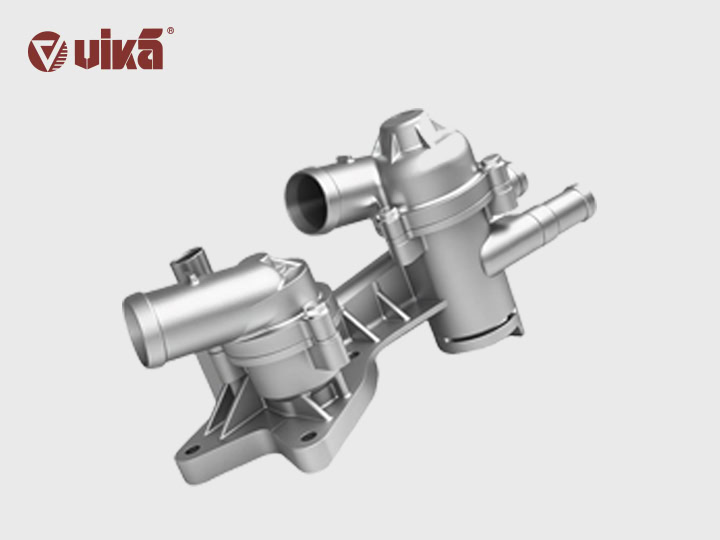
Advantages of vika thermostat:
Stronger Structural Integrity: high-strength aluminum prevents cracking at threaded mounting points.
Superior Sealing Performance: precision-machined connections improve roundness and flatness, reducing coolant leakage.
Outstanding Heat & Aging Resistance: Resists high-temperature aging and brittleness common in plastic housings.
Enhanced Heat Dissipation: higher thermal conductivity helps maintain stable engine temperature.
vika thermostat 24-month warranty.
Recent News
- -Fix Audi Noise & Steering Pull: vika Control Arm Bushing Kit
- -VW 1.6 2.0 TDI Tandem Pump 04L145208D: Failures & vika Fix
- -vika Steering Tie Rod Repair Kit: Fix Chassis Noise & Drift
- -vika Thermostat Assembly: Designed to Solve Coolant Leakage and Check Engine Light Issues
- -Connecting the World and Empowering the Industry! vika DPA Debuts at Automechanika Frankfurt 2026
- -Why Should the Timing Belt and the Coolant Pump Be Replaced as a Set?


