

What are possible reasons for hub unit failure?
08-28,2023
A hub unit acts as the connection between a tire and a knuckle. Its main purpose is to bear weight and guide precise rotation of the wheel hub. It has an average service life of 130,000 to 160,000 kilometers. This unit plays a crucial role in supporting both axial and radial loads.
Symptoms of a broken hub unit:
1. Noise
A buzzing sound may occur and increase with acceleration or steering of the vehicle;
A loud whining sound or friction sound may persist.
2. Abnormal steering wheel
The steering wheel may become loose or move excessively;
Vibration may occur and change with vehicle speed or steering.
3. ABS system malfunction
Reasons for hub unit failure:
1. Improper installation: Improper tool operation can cause damage to the exterior or interior of the bearing on the wheel end.
2. Road conditions: When travelling in deep water or mud, pollutants may penetrate the sealing ring and enter the bearing, resulting in contamination of the lubricating grease and wear of the bearing.
3. Inferior product: After operation for long under huge pressure, products made of inferior materials can wear out and fail prematurely due to heat effect.
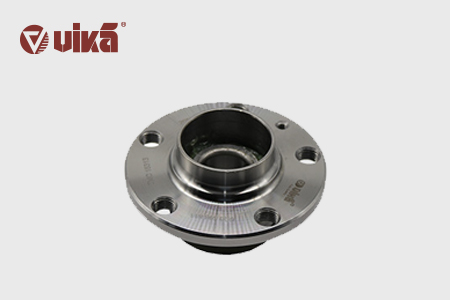
Advantages of vika hub unit:
I. Material:
Grease: vika hub unit makes use of Japanese KYODO YUSHI AF-1 grease designed specifically for automotive hub bearings. It can be used safely even under harsh conditions (-20°C~170°C). Extreme pressure additives and oxidation stabilizers have been added to enhance load capacity and resist leakage due to softening.
Steel ball: The curvature and position of each steel ball and clearance between balls and bearing are highly uniform. During operation, the steel balls rotate smoothly without any obstruction and are highly resistant to wear.
II. Process:
High-frequency quenching process: The high-frequency quenching layer of the inner and outer rings is 2.5 to 3.5 mm in depth, and the quenching depth and hardness are strictly controlled to ensure long service life of the bearing.
Heat treatment process: The vika hub units are based on a Bainite process that leads to higher toughness, prevents cracking during rotation, and prolongs the service life.
Turning process: A mud water tank design is adopted to allow mud water to be thrown out easily. The CNC automatic turning process not only ensures smooth and wear-resistant tool lines on the surface of every component and uniform chamfering, but also leads to high dimensional accuracy and stability of the components.
Rolling process: vika hub units are produced in strict accordance with OE standards, and their surface rolling finish reaches Rz0.2 grade. This rolling process is an alternative to corresponding heat treatment process.
Thread: With smooth surface, the threads provide good self-locking and wear resistance, are easy to assemble, and feature high strength.
Gear broaching: The gear broach moves from the bottom diameter of the groove and completes an operation cycle in one travel, thus meeting the tolerance requirements of the guide teeth and contributing to more accurate installation of the guide teeth.
Revolving riveting: The revolving riveting mouth is a circular arc formed by spinning in line with OE standards.
Recent News
- -Fix Audi Noise & Steering Pull: vika Control Arm Bushing Kit
- -VW 1.6 2.0 TDI Tandem Pump 04L145208D: Failures & vika Fix
- -vika Steering Tie Rod Repair Kit: Fix Chassis Noise & Drift
- -vika Thermostat Assembly: Designed to Solve Coolant Leakage and Check Engine Light Issues
- -Connecting the World and Empowering the Industry! vika DPA Debuts at Automechanika Frankfurt 2026
- -Why Should the Timing Belt and the Coolant Pump Be Replaced as a Set?


